It had been a bad day… a really bad day. When Ella thought about it, it was hard to think of anything that had gone right. She had woken up late, and by the time she got down to breakfast her little brother had eaten the last of the Coco Pops, and that had meant that Ella had had to have cornflakes. When she grumbled about it, her mum said, ‘Well there is always toast.’
‘I don’t want toast,’ said Ella.
‘You were happy with toast yesterday,’ said her Mum.
‘That was yesterday,’ said Ella.
‘Well, it will have to be cornflakes, then.’ And her mum put a bowl of cornflakes down in front of her. Ella looked at the bowl of cornflakes. She sighed and took a couple of mouthfuls from it. It was not as good as coco pops. Her brother Hamish was down from the table now and playing with his Duplo in the lounge. ‘Hamish gets all the good things,’ she said. ‘He is allowed to play and he ate all the coco pops. He is full of coco pops happiness… my coco pops happiness.’
Her mother was fixing the lunches at the kitchen bench. ‘Are you eating up Ella? Come on we need to head out to school soon.’ Ella took another mouthful of cornflakes. Then she pushed her spoon through the middle of them and made a channel of milk down the centre of the bowl. They had been learning about New Zealand at school. ‘This is the North Island and this is the South Island and this is the Milk Strait,’ she said to herself.
‘Ella, are you eating or playing?’
Ella took another spoonful of cornflakes.’ and the North Island is not so big anymore.’
Hamish came in to show her the truck he had built.
‘That is not a very good one,’ she said.
‘Tis good one,’ said Hamish and his bottom lip trembled.
‘Teeth, Ella!’ called her mum from the kitchen.
Ella ran to the bathroom before Hamish started to cry.
Her Mum came in to the dining room and picked up Hamish. ‘There, there, Hamish, what are you crying for?’ she said. ‘What a lovely truck you have made. Ella,’ she called ‘where is your lunchbox. It is not in your bag and it is not on the bench.’
The lunch box was nowhere to be found. ‘It’s a good lunchbox. You need to look for it at school,’ said her Mum.
So Ella ended up having to take her lunch in her old lunchbox with the embarrassing Little Mermaid picture on it. ‘I am so over the Little Mermaid,’ she scowled as she climbed into her booster seat in the back of the car. They were late for school because of the lunchbox, and Mrs Rennie, her teacher, sent her to the office because she had already marked the roll. It was not a good day.
At playtime Suzy Swanson didn’t want to play with her because she wanted to play with Bronwyn Wright instead. That meant that Ella had to play with Elizabeth Fraser and Moana Erueti. Moana was all right but Elizabeth was bossy.
There were ham sandwiches in her lunch, when her Mum knew that she liked Nutella ones. Elizabeth was so bossy that Ella went off to play on the bars by herself. It looked like Moana was thinking about joining her but in the end she didn’t.
Mrs Rennie took them to the library after lunch, but Ella wasn’t allowed to get a book out because she had forgotten to bring the book, that she did have out, back. She was mad about that, because it wasn’t much of a book. It was all about ice skating. She had only got it out because Suzy Swanson liked ice skating, and Suzy was her friend. But not today. Suzy was sitting down beside Bronwyn Wright looking at a magazine together and smiling. ‘I hope she sits on a nettle,’ thought Ella.
Just before home time Mrs Rennie took them out for PE. They played four square, but today Ella couldn’t get past the second square. She was sure that Bobby Williams had called her out when she wasn’t. It was a bad, bad day.
Mum was a bit late to pick her up so she had to wait. When she climbed in she kicked something under Mum’s seat with her foot. It was her lunch box. ‘Not much use finding it now!’ she thought. Then they had to go shopping for a raincoat for Hamish because he was getting too big for the one he had. There was a purple jacket that Ella liked, but Mum said that her one had lots of wear in it yet. Hamish was singing about his new coat as he held on to it in his car seat in the back of the car. And that just made Ella think about how she wasn’t allowed one.
‘You know,’ she announced when they got home ‘ I might just look for a new family.’ And she stomped up the passage kicking Hamish’s truck to pieces on the way, and slamming the door to her room. A minute later while Mum was busy giving Hamish a hug, she quietly opened the door and stuck a sign on it. ‘KEEP OUT!!!’
It was very quiet down that end of the passage for a long time. When Dad opened the door to tell her it was teatime Ella was asleep. He closed the door again quietly.
When he came back again later with a tray of food Ella was awake. ‘Hey, kiddo,’ he said, ‘how was your day?’
‘Not so good,’ she said.
‘Tell me about it.’
And so she did. ‘Whew,’ he whistled, ‘that was quite a day, wasn’t it?’
‘Yep,’ she said, it was a bad, bad day.
And that night after her bath, her dad sat on her bed and read her a story.
………………….
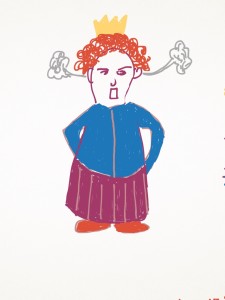 The tiny kingdom of Fifefirey was ruled by the Fury family. Princess Angie was a Fury. From the time she was born she could bellow so loud that it could be heard around the greater part of the Kingdom.
‘Ah,’ said her father, King Ferdinand the Furious, proudly, ‘Listen to that wailing. That is the sound of a Fury.’
Her mother, Queen Jane, bought ear muffs.
By the time she was three Princess Angie could yell so loudly that the vibrations would knock pictures off the walls two rooms away. She had a fearsome temper. There was a ding in her nursery wall where she had hurled the golden rattle, which her father had foolishly given her. It was lucky for her that she was a princess or she would have had no toys that were unbroken. Her nannies never stayed long. Her tutors came and went. She was her mother’s worry and her father’s pride and joy. ‘Such lungs!’ he would exclaim. ‘Such spirit! Angie, my angel,’ he would call her. But to almost everyone else she was ‘Angie the Angry.’
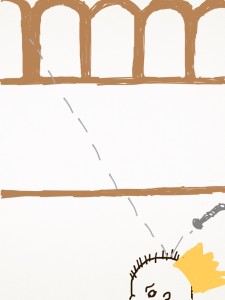 Angie may have been a princess, but her life was touched early by tragedy. Her father, King Ferdinand, had a temper as fierce as his daughter’s. Queen Jane did her best to contain it, but one day when his toast was too cold, and his bath was too hot, and his prime minister was too late, he picked up a lead candlestick and hurled it at the Palace window. Unfortunately it hit the masonry and bounced back and hit him on the head.
It was a tragic and untimely end – death as a result of an accident at his own hand. Queen Jane had to rule in his place until Princess Angie was old enough to take over.
 Angie had a cousin on her mother’s side whose name was Patience Fairweather. It can be lonely being a princess, and Patience was Angie’s very best friend. Patience was a sweet girl with a lovely singing voice. Whenever Angie was worked up over something Patience could somehow quieten her down. She never shouted at her. She did not run to and fro like the adults did. She just sat and swung her legs and hummed or sang or played. In fact she acted as though Angie wasn’t even in the room. After a while Angie would blow herself out, enough to see that there was just her and Patience, and she would quieten down. Then Patience would say, ‘ Hey Ange want to do this?’ or ‘Shall we play that?’ The adults would return to find the 2 girls happily at play. Patience was a very good friend.
Then one day Patience got sick, and quite suddenly she died. Everybody was sad. Patience was such a loveable girl. Angie was sad too. She was sad and angry all at the same time. In fact she was furious. She shut herself in her room and she bellowed and she broke things, and people were afraid to enter in case she threw something at them. She was in there for days and the queen was very worried. She summoned the Royal Physician.
The Physician looked around the family portraits of all the Fury’s on the wall, all the old kings and queens of Fifefirey, including the late king. ‘Your Majesty,’ he sighed ‘it is easier to deal with a little fury than a big one,’ he said. ‘If you act now you may avert a bigger tragedy later.’
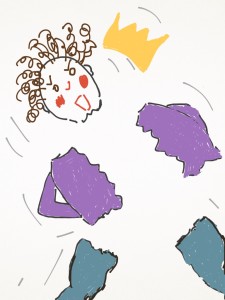 The Queen looked at the portraits too… So many of those Furys had died young. …her own husband, King Ferdinand the Furious… his father King Ferdinand the Fierce, who had simply exploded in rage, in an explosion so fierce that they never ever found his royal slippers. The Royal Physicist at the time had maintained that they must have spontaneously combusted. His uncle Vernon the Volatile who had walked off a cliff in blind fury. Such a waste of life. And here was her own little Angie threatening to go the same way.
That made Queen Jane angry, in a way that she had never been angry before. She had had enough of this Fury family and the way it destroyed itself. It could not be allowed to continue to happen. She marched down to Princess Angie’s room, and ducked the jug of juice that was thrown at her. ‘You are coming with me’, she said. ‘I have something to show you.’ She grabbed her daughter’s hand. Princess Angie was so surprised that she went with her. They stood in front of the family portraits and Queen Jane told her daughter all the stories about them that she knew…. so many people who died too young destroyed by their anger.
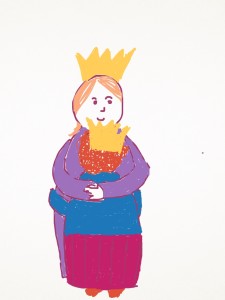 She gave her daughter a hug and looked her in the eyes. ‘I know you are upset because Patience died. I am upset too. She was a wonderful girl and a very good friend to you. Life can be hard, Angie. Often it doesn’t turn out as we wanted. But do you think that shutting yourself in your room, and trying to hurt anyone who comes near you, is a good way to remember Patience? Do you think Patience would want you to do that? Wouldn’t it be better to remember Patience by doing some of the things that you used to like doing together?
It is not wrong to feel angry, but you can choose what you do with it. You mean so much to me. I would be so terribly sad if you chose to let anger destroy you.’ And the Queen shed a tear or two and Princess Angie did as well.
Princess Angie still got angry. Sometimes she got very angry, but somewhere in her anger her mother’s words would come to her. ‘You can choose what to do with it Angie. You mean so much to me that I would be terribly sad if you chose to let anger destroy you.’ And Princess Angie would remember her friend Patience, and she would sit where she and Patience used to sit and she would hum one of the tunes that Patience used to hum. And when she did that, it seemed like Patience wasn’t so far away from her after all, and somehow her anger dissolved away.
……………………
‘And that, Princess Ella, is the end of the story.’
‘Thanks Dad,’ said Ella. She leant over and gave him a kiss. ‘I think I will stay in this family after all.’
‘That’s a relief,’ said Dad. ‘You know, of course, that in this family we don’t slam doors.
Ella nodded. ‘Sorry,’ she said.
‘Hey, tomorrow is a new day,’ said her dad. ‘And at least you found your lunch box.’ And with that he kissed her goodnight.


