Categories
Faith Explorers Recent Topics

4 November 2013 Book ‘The Future is Now’: Chapt 15 of “Inequality in NZ” edited and collated by Max Rashbrooke

The chapter author, Linda Tuhiwai Smith, suggests that we are creating the future now in the values and attitudes of today’s children/tomorrow’s citizens.  Evidence and facts (in this case about inequality) are interpreted by those in power as they ‘can determine what is truth and what is nonsense’ and therefore what can be ignored.  We all believe what we want to.  This can only change with compelling stories, vision, courage and persistence.  Ultimately should we harness people’s ‘outage’ to effect change?  What form might effective ‘outrage’ take?

We noted that there are different kinds of poverty – not just money but also time, skills, influence, ability to make choices, education, literacy.  Addressing only one aspect will not address the others!  The author suggests that a common perception is ‘It is the fault of poor people that they are poor’, but when poverty exists across most elements of modern living, the odds are heavily stacked against them.  Often the circumstances are not of their own making, many kinds of poverty have been inherent aspects of their whole lives to date.

The author argues that education is a key factor in addressing poverty.  The group noted that this is only the case if there are jobs available which match the range of skills that the society can offer from semi-skilled upwards and that all jobs provide a level of net remuneration which allow a sufficient standard of living to participate in society ie a living wage.  The NZ economy has removed many low paid/skilled jobs as businesses close; in some cases such jobs have been replaced with higher skilled roles – effectively locking out the lower skilled.  Many roles eg looking after the young and the old and prisoners are not greatly valued by society, so are low paid and additionally have not been well served by the ‘business for profit’ motive. The great proportion of those employed in the tourist industry eg hospitality, are not skilled or well paid, but the Government is placing great emphasis on increasing tourism.  It was suggested therefore that tourism is not a route which will lead a great number out of poverty.

It is our impression that most Government agencies regard beneficiaries as trying to rip-off the system; there is a basic lack of trust which results in unnecessary hardship and high levels of bureaucracy re-applying for benefits and challenging decisions.  (Note these also put the ‘poor’ at a disadvantage.) Surveys suggest fraud is quite low; it would be more fiscally significant if more rigour was applied to simplifying tax law, closing loop holes and chasing down tax evaders.

Categories
Faith Explorers Recent Topics

21 October 2013 Book ‘Inequality a NZ Crisis’: Chapt 2 “Inequality in NZ” by Max Rashbrooke

This chapter gives a very sobering picture of inequality in terms of total income and net wealth and their trends over the last 60 or so years.  Basically half the NZ earning population earns less than $24,000 pa including any social welfare support and tax credits.  The top 10% earn more than $72,000 and the top 1% more than $172,000.  In terms of wealth, NZs 2.9M adults own $470Bn, with the top 1% owning 16%, the top 10% owning 50% of net wealth and the lower 50% owning 5% of the wealth or an average of just $6,000 each.  The country-wide average wealth per adult is just $70,000.  What’s more, those on the lowest incomes have seen very little increase in dollar terms since 1984.. This is not the case for the top 10%.  (So much for the trickle down theory!)  We effectively have a regressive tax system when GST is taken into account.  The chapter has many similar illustrations of the wide inequality gap – many from ‘official’ government sources.

We were surprised and concerned by the inequalities portrayed in the figures.  The ability to support an individual let alone family members on such low income levels and enjoy a reasonable standard of living is impossible.  One consequence is having to take multiple jobs (if available) to make the ends sort-of meet; this has a high negative impact on family life and social cohesion. Bill English is quoted as being comfortable with the level of income inequality and doubts governments could combat it as they ‘don’t have the levers’.  We strongly disagree and feel that our government should be making urgent steps to address inequality before society disintegration forces unplanned changes upon us.

Chapter 13 ‘The Rewards of Work’ notes that we have historically chosen the ‘low wage’ economic model and this has contributed to our fall in relative rankings in the OECD to 21st (out of 34).  Our productivity is also poor.  As the saying goes, we can’t expect different outcomes if we keep doing the same things – and things need to change.

Categories
Faith Explorers Recent Topics

14 October 2013 Book ‘Inequality a NZ Crisis’: Chapt 1 “Why Inequality Matters” by Max Rashbrooke

We started by watching a 10 mins video of the Q&A session which followed the ‘Forums for the Future between Rich and Poor’ seminar at Soundings Theatre.  (See this page entry for 16 Sept 2013.)  Points addressed: globalism and international connectedness have gone ‘too far’ for NZ to go alone by adopting strong socialist policies, general support by speakers  for universal child support and for access to other services, need to raise involvement of fathers in estranged relationships with their children, more bi-cultural emphasis – as this is the essence of ‘being a kiwi’.

Chapter 1 of the book ‘Inequality’ provides a general summary of the critical situation NZ is in.  This engendered considerable discussion including the following points: we need to value ‘service’ jobs more so that they are paid what the job is actually worth (to society as a whole); prices for services eg electricity have increased along with company profitability but this has not been reflected in wages; the trickle-down benefit touted in the 80s has proved to be a lie; when lower paid people earn more they tend to spend more – assisting local economic activity for others; the racial divide evident in the statistics is a major concern as a source of divisiveness in NZ society; those on minimal income are caught in a poverty trap not of their own making.

We could not accept that nothing can be done and while others eg Treasury, Reserve Bank, Unions, and large/international businesses all have a role to play, the Government can still exert considerably influence and pressure should it choose the do so.  In Australia, the Union movement is much stronger than in NZ which by keeping wages higher, has taken the country on a different path than our low labour cost alternative.

Categories
Faith Explorers Recent Topics

23 September 2013 “Mind the Gap” a documentary produced by Bryan Bruce first shown on TV3 in Sept 2013; can be viewed from TV3 website.

This is a hard hitting doco which starts with the searching question “What’s an economy for?”  We would do well to ponder this and challenge politicians for their view and actions they would take to bring it to reality.   The film is full of disturbing factoids – poor families unable to survive as their income, including Social Welfare payments, is barely sufficient to exist.  In NZ the gap between the top 10% and the bottom 10% is growing faster than in any other country.  Bryan laid the cause of this trend over the last nearly 30 years at the door of Neo-liberalism as promoted by Reagan and Thatcher. Their 3 fundamental economic planks of asset sales, privatisation and the tickle down theory (of wealth) have failed in not providing the general population with greater wealth or opportunities.  The result has been that the wealthy have grown even more wealthy.  Why are CEOs paid 100s of times more than the shop floor workers on who the business depends?  Of the detected fraud in NZ, it is estimated $23M arises from welfare payments with 800 prosecutions (60% sent to jail) and $1 – 5Bn in tax evasion with only 20% jailed.  Why not more focus on evasion – or at least, eliminating the legal loopholes? Is the purpose of our life to make money?

The programme prompted considerable discussion: we are actually more heavily dependent on each other (to design, manufacture and provide the technology that underlies everyday living) yet we are experiencing greater social/society dis-integration; every aspect of life and living is being monetarised; less direct Government involvement in favour of markets which favour those who can pay.  Could the ‘Living Wage’ campaign be part of the solution?

Categories
Faith Explorers Recent Topics

16 September 2013 ‘Forums for the Future between Rich and Poor’ video of a seminar at Soundings Theatre, Te Papa on 13 September 2012

The forum provided an opportunity for 3 speakers to address their concerns for, and the impacts of widening inequality in NZ.  The speakers were preceded by Max Rashbrooke who previewed the book he is editing with others entitled “Inequality”, which has subsequently been released in mid 2013.  Inequality in NZ increased rapidly between mid 80s and mid 90s.  The average household in the top 10% now has nine times the income of one in the bottom 10%.  The top 1% of adults own 16% of NZ’s wealth; the bottom 50% together own ~5%. The seminar speakers were from Wellington’s Downtown Community Ministry, Otago University and an economist.  All noted that a high level of inequality will not result in a healthy vibrant, cohesive society and therefore needs to change.

A good discussion followed with challenges to expenditure on infrastructure versus health and education, tax rates on very high incomes, Government support for industries and specific companies, those in power who are out of touch with those with $40 per week available for food, clothing, etc, graduates who can’t get work in NZ.  An attitude change is required – for the vast majority of the poor it’s not their fault – the system has to change to provide better pay and more opportunities.

Categories
Sermons

Thinking About Mission – Luke 10: 1-12

Go therefore and make disciples of all the nations, baptising them in the name of the Father and of the Son and of the Holy Spirit, and teaching them to obey everything that I have commanded you.  And remember, I am with you always, to the end of the age. 

Matthew’s Great Commission has been an important and formative text in the church’s understanding of its mission.  Sometimes, I think, those who are enthusiastic users of it could be a bit more imaginative and expansive on what that Christian discipleship entails.

The text has had a particular impact on the modern missionary movement from its beginnings in 19 century evangelicalism – the Church Missionary Society, the London Missionary Society are children of this.
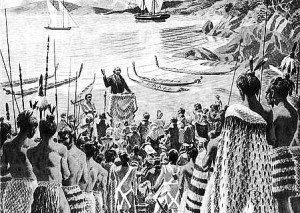
marsden_Xmas_1814

 Samuel Marsden preaches the first Christian sermon on New Zealand soil.   25 Dec 1814.   

It was the text behind John Mott’s cry ‘The evangelisation of the world in this generation.’  The Student Volunteer Movement that John Mott led was an ancestor to the Student Christian Movement and the Tertiary Students’ Christian Fellowship.

Another of the important texts on mission is Jesus’ statement before the home crowd at Nazareth, of what he was on about.

The Spirit of the Lord is upon me, because he has anointed me to bring good news to the poor.  He has sent me to proclaim release to the captives and recovery of sight to the blind, to let the oppressed go free, and to proclaim the year of the Lord’s favour. 

This statement about God’s mission in the world being about the restoration of social and spiritual wholeness, healing and release proclaimed and modelled by Jesus and fulfilled through him, is perhaps the favoured mission text of today (in theory at least).

I’ve been reading a book lately that takes Luke 10: 1-12, the passage about the sending out of the 70, and suggests that we would do well to reflect on what it tells us, about how the church should go about participating in God’s mission.   I haven’t made up my mind about whether the text can bear all that this writer hangs on it, but he makes some interesting and challenging observations that are worth thinking about.

The author’s name is Alan Roxburgh.  His basic thesis is that ‘the mission of God’ is the centre of the gospel and the central concern of Jesus.  It is not about the church, he says.  It’s not about church planting or church growth or healthy churches or any other form of church survival.  Communities that are shaped by the Christian gospel are called first and foremost to be people who are committed to partnering with God in God’s mission to the world.

That partnership with God in God’s mission may sensitise us to pastoral needs, justice issues, spiritual needs, conservation concerns, to places that are doing good work and could do with a helping hand.  It may draw us to pray, to speak, to do, to share resources, time, expertise, something of our own story, something of the Christian story.   Whenever our sense of the grace, love, justice and faithfulness of God motivates our responses to the world around us we are partnering God in God’s mission; we are doing kingdom work.  We need, Alan Roxburgh says, to rediscover that the gospel is the hope for all human life and for the creation that surrounds us.

Churches don’t grow.  We  grow.

And when we grow, churches change,

and when churches change

Communities are transformed,

and God’s mission is to transform the world.

Nigel Hanscamp, Making Connections Weekend

The gospel of Luke was probably written in the last quarter of the first century.  It was written with Gentile congregations in mind.  By the time the gospel was written Jerusalem had very likely fallen to Titus who would soon become the emperor of Rome.  With its fall those who had been associated with the most Jewish of the Christian communities had been scattered or had perished.  By 75 AD there would have been a good number of 2nd generation Christians among those to whom Luke was writing.

Roxburgh believes that Luke wrote to encourage Christians who were having a crisis of faith.  The expectation of the earliest Christian communities was that within a short time Christ would return and the Kingdom of God would come in its fullness and the kingdoms of the world (including the superpower of Rome) would come to an end.  As time went on this expectation was needing to be looked at again.  Christians were a minority, living in countries that had been occupied by the Roman army and incorporated into the Roman Empire.  Life was not always easy.  It was not uncommon to be subjected to harassment and discrimination.  It was tough and costly believing and giving allegiance to an alternative kingdom, when the signs of the power of Rome surrounded them on every side.  The Roman Empire seemed as entrenched as ever.  Was the cost of being different too great?  Why was God taking his time in bringing things to a close? What was God up to?  Who was really winning?

This is the context of Luke’s audience.  In the gospel itself the story of the sending out of the seventy is surrounded by stories that indicate that the gospel from its beginning had a mixed reception, and also that it has never been easy to follow Jesus.  In fact in the section before this passage Jesus’ words are more discouraging than encouraging to those who register expressions of interest in following him.  ‘You’ll be living on the margins.  It will demand your undivided allegiance.’  It is clear, too, that the highly regarded and well known were disproportionately absent from Jesus’ band of disciples.  All in all they were a pretty ordinary bunch.  ‘Thank you God,’ Jesus says, ‘that you have revealed these things to children and not to the smart and savvy.’  Luke’s audience will have recognised something of themselves and their experience in all these things.

Jesus has set his face toward Jerusalem.  He sends 70 of his followers out ahead of him into the places that he will be passing through.  They are to travel light, so light that they will be forced to depend on whatever hospitality is offered to them- no purse no bag no sandals.  (‘Comb and toothbrush and no extra luggage’- The Message.)  They are to stop where they are first welcomed.  They are not to move around looking for the best place to stay.

This is a very different approach to mission from the default of most Western churches.  Here the followers of Jesus are recipients of others’ hospitality.  They are not creating a programme or responding to what they guess is a need or gap in services in the community.  They are not creating a dependence on themselves for a service, and hoping by that that people might stick around.  They are not even extending hospitality with no strings attached.  Instead they are the powerless ones, dependent on those who have allowed them to move in and live alongside them, sharing in the work of the household and sharing food at their table.  This is the sort of space where genuine conversations, free from church agendas can take place.

Alan Roxburgh paraphrases, ‘If you want to discover and discern what God is up to in the world just now, stop trying to answer this question within the walls of your churches.  Like strangers in need of hospitality who have left their baggage behind, enter the neighborhoods and communities where you live.  Sit at the table of the other, and there you may begin to hear what God is doing….  Part of Luke’s response to his audience is that they will rediscover the meaning and shape of the gospel as they enter the towns and villages where the Spirit has sent them to live.’

Roxburgh reflects that the church in this passage is not in a gathering of like minded people in a scheduled religious meeting, it is in the living spaces and working spaces of people who are largely outside of those meetings.  It is sitting at their tables, listening to their stories, breaking bread with them, and entering into a human dialogue that is not a well- rehearsed sales pitch.’

Now there a lot of us at Tawa Union Church who have or have had very strong links and connections with our communities.  We have an older generation here, in particular, who were instrumental in setting up some of the infrastructure of our suburb.  Many of us too have worked in community oriented professions or in the public service.  And others of us have worked with integrity in the private sector.   We have a strong tradition of community service in this church and in fact in the suburb.

carrier_pigeon What we do sometimes lose touch with, though, is a sense of being sent.  The 70 were sent out by Jesus; that is what gave their journey its purpose.  It wasn’t just a billeting experience for their own development, or to do a bit of good.  Jesus had sent them to speak God’s word of peace and wholeness, to heal the sick and to announce the good news of God’s kingdom- a very different sort of establishment to the Roman Empire.  We need to recover our belief that God has sent us to be part of the communities that we connect with.

God hasn’t sent us there to interject with trite religious formulas or give some Christian sales pitch.  God has sent us there to rub shoulders with those who are in those communities, to work alongside them, to listen to their stories, to share coffee with them and enter into genuine dialogue.  As we do that and reflect on our own stories and the stories of God’s people, we may notice what God is up to in that place and discover our ministry there.  It is our sense of being sent that opens our eyes to see our life’s journey and our work, paid and unpaid, as a calling.  When we wake up to our life as a calling, it is amazing how often we catch sight of God.

The 70 came back to Jesus bubbling with all that had happened, full of stories of what God had done through them.  Jesus says, ‘That’s great, but the real triumph is not your authority but God’s authority over you and God’s presence with you.  It’s not what you do for God but what God does for you- that’s the agenda for rejoicing.’ It is our ongoing awareness and celebration of God’s kindness and grace towards us that gives our ministry balance and keeps it genuine.

Clare Lind

Reference:
Missional- Joining God in the Neighborhood by Alan Roxburgh;  Baker Books, 2011

Categories
Faith Explorers Recent Topics

9 September 2013: ‘The Heretics: Adventures with the Enemies of Science’ a book by Will Storr – audio interview

This book explores the author’s view that we are ‘programmed’ that when we believe something we become deaf & blind to any facts that do not support our viewpoint.  Scientific facts or data or subject matter experts make no impression and are easily dismissed.  We don’t challenge our firmly held passionate beliefs; we are very good at justifying our positions – at least to ourselves!  Intelligence is no barrier to believing wacky things.   We have always been credulous- its not a 20th /21st century’s phenomenon.  Interestingly this is not a simple anti-science positioning, but much deeper within the individual – they KNOW.

Categories
Faith Explorers Recent Topics

2 September 2013: ‘THE ROLLER COASTER JOURNEY OF CHANGE’ a presentation developed by Kevin Ward

We reviewed the slides on the above presented to Wellington Presbytery on 30 August 2013 by Kevin Ward.  The first part provided graphic statistical information on church membership, attendance, age and ethnicity profiles over the last 100 years or so.  The membership and attendance and age profiles all indicated what we all experience, decreasing numbers and over-representation in the older age brackets.  The mix of ethnicities is rapidly changing.  These are a feature of all mainline churches and ECP branches.  An interesting observation was that the challenges for congregations are too great for them to overcome alone, hence the importance of the roles to be performed by Regional organisations – Presbytery and Synods.  The number of ‘moderates/liberal’ theological position is weakening (further!); fastest ‘growing’ are those congregations with a clear theological position and contemporary worship forms ie conservative.  Need a sense of transcendence, an encounter.  In the future there will be less significance on ‘place’

Part 2 was about change and the change process.  The learners are the winners as change is continuous which makes long range planning more difficult; any plan therefore needs to be adaptable to the changed circumstances.  The longer a congregation stay with the status quo, the harder and more drastic the changes become.  Change is difficult!

Categories
Faith Explorers Recent Topics

19 August 2013 A Look at the New Testament Through Contemporary Eyes an ebook by Jean Conley

This short booklet, summaries how the NT came into existence and how modern scholarship has dispelled some historical misconceptions eg the apostles didn’t write the gospels, they were not written by eye witnesses, the order as they appear in the NT is not the order in which they were written.  The emphasis says the author is to present the data – rather than the theology – and let the reader come to their own conclusions.

The 3 chapters are short and present material that will be of little surprise to those with previous exposure to ‘Liberal’ Christian thought.  Each chapter is followed by some study questions.

Our group thought the book to be a useful reference and especially of interest for people willing to consider the Bible (perhaps afresh) in the light of contemporary knowledge and not as the immutable “Word of God”.

The book is available for download from this page (see link bottom right).

Categories
Faith Explorers Recent Topics

12 August 2013 The Earth Charter, an additional resource associated with The Journey of the Universe

The Earth Charter is a declaration of fundamental ethical principles for building a just, sustainable and peaceful global society in the 21st century.  It seeks to inspire in all people a new sense of global interdependence and shared responsibility for the well-being of the whole human family, the greater community of life, and future generations.  It is a vision of hope and a call to action.

The Earth Charter is centrally concerned with the transition to sustainable ways of living and sustainable human development.  Ecological integrity is one major theme.  However, the Earth Charter recognizes that the goals of ecological protection, the eradication of poverty, equitable economic development, respect for human rights, democracy, and peace are interdependent and indivisible.  It provides, therefore, a new, inclusive, integrated ethical framework to guide the transition to a sustainable future.

Some of the points we discussed were as follows:

  • The need to balance economic development with environmental protection and social justice
  • The enlarged perception of home, and the recognition that we are a part of a large family of life, including not only other humans, but also other species.
  • The awe and wonder arising from our increased understanding of the intricacy and complexity of life.

(Notes by John M)