Categories
Faith Explorers Recent Topics

6/5/13 Why Weren’t We Told? Compiled and edited by Rex A. E. Hunt & John H. W. Smith: Being a ‘progressive’ Community in the Bible Belt by John Shuck & Not Forgetting the Children! A ‘progressive’ Christian Spiritual Curriculum by Deshna Ubeda

The Progressive community in the Bible Belt was very clear about where they stood without being exclusive.  While such statements will not satisfy everyone and some may disagree to such an extent that they leave, such statements do provide a sense of what that community stands for.  Trying to satisfy everyone can mean standing  for nothing.  Having clear objectives/mission and then executing accordingly provides focus and motivation.  Interestingly the largest church group is the Peacemaking Committee – ie addressing environmental, justice and peace issues – suggesting a group of highly motivated people trying to make a difference.  They challenged local strip mining, hold an Evolution Sunday/Weekend close to Darwin’s birthday, hold equinox and solstice celebrations, use drumming, dancing and blogging extensively with a un-apologetic viewpoint.  Two quotes of their situation ” Spiritual bullying is a reality wherever you go.” and “Being progressive … is about being human and being in community.”  Amen to that.

In the last few weeks, as we have delved further into this publication, it has proven to be a very interesting collection of short essays, sayings and thought pieces.  Some will make you laugh, some cry, some cause to muse over and most will cause you to pause and think.  It’s not a book one reads from cover to cover, but to dip into read a few, pause for reflection, consider application and move onto something else.  Highly recommended.

Categories
Faith Explorers Recent Topics

28/4/13 Worship Service Believing or Doing – that’s the question

We lead the worship service at 9:30am on ‘Believing or Doing – that’s the question’ which outlined the development of the Apostle’s and particularly the Nicene, Creeds.  The service included a dialogue discussion and a time for reflection via pictures and music.

Categories
Faith Explorers Recent Topics

15/4/13 The Living Wage

We attended a presentation and discussion on a regional launch of the Living Wage Campaign hosted by the Wellington Anglican diocese and Tawa Baptists in the Tawa College Hall.  The evening was introduced with a video about how individuals in the US had been assisted back into the workplace and the impact his had had on their lives.

Then there was then a presentation on how the Living Wage of $18.41 for Wellington and $23.11 in Auckland had been devised. The Living Wage assumes 1.5 fulltime employment for a family of 4.   33% of wage earners earn less than the Living Wage.  This compares with the minimum wage of $13.75 (and from 1 May a youth rate of 80% of that ie $11.00).  Attendees were encouraged to ask retailers if they were prepared to pay, or move towards, the Living Wage and give our support or otherwise to those businesses.

Categories
Sermons

Opening the Way – Acts 11:1-17

The first railway line out of Wellington went via what is now the Johnsonville line.  The line was put in by a group of Wellington business men.  They were impatient with governmental procrastination.  They could see that a railway line north was critical to the economic future of the region, and so they formed the Wellington Manawatu Railway Company.  The line went beyond the current Johnsonville line down through Glenside fairly much along the current motorway alignment to Tawa.  By 1885 it went as far as Paramata, linking the Wellington and Porirua Harbours.

In 1908 the company was bought out by the government.  The Main Trunk Railway through the North Island had just been completed and the Wellington Manawatu Railway Company line became the southernmost section of it.

I don’t know whether you have travelled the Johnsonville line.  It is a windy route around the northern hills.  There are seven tunnels on it and a number of fairly tight bends – which, I gather, is why they are having trouble with noise on it from the new Matangi units.  All going well it took 45 minutes to travel from Wellington to Tawa along it.  While the line no doubt served the needs of the inner northern hill suburbs it was a circuitous route out of Wellington for freight trains and passengers going north of Wellington.

A proposal for a tunnel through the hill to shorten the route was being put forward as early as 1913.  World War 1 stopped the proposal going any further and it was 1923 before any action was taken on it.  Tenders were put out for the two tunnels that would need to be built.  The idea was to use New Zealand contractors for the first and shorter of the tunnels, and to use experienced overseas contractors for the long tunnel.

The local contractor failed to get going on the job and the overseas tenders were too high, so the Public Works Dept decided it would just have to do the job itself.  There was a lot of infrastructure to set up before the tunnels even began.  It wasn’t until 1929 that they began the actual tunnelling.  They began by drilling from both ends at once, and the initial holes progressed at a rate of around 18 metres per week.  That initial hole was then enlarged, reinforced and lined – a slower task that went at the rate of around 13.5 metres per week.

While the tunnels started in hard stable rock, it was not long before the tunnellers met broken rock and underground streams.  The opening of Tunnel No 1 is on the Wellington fault line and the rock had splinter faults that the geologists had not been aware of.  It was hard and dangerous work.  As well as the tunnels, ventilation shafts and service tunnels had to be drilled.  Midway through 1934 the tunnels were handed over to the Railways Dept to lay the track and to put in the electrification.  Electrification was necessary because the tunnels were too long for steam engine to negotiate safely.  Three years after the handover trains were regularly running through the tunnel.

The longer of the two tunnels is over four kilometres long.  When it was built the Tawa No 2 tunnel was the second longest tunnel in New Zealand- the one at Otira being the longest.  Today Tawa No 2 is still the 4th biggest double track tunnel in New Zealand.  Once it was in use, Tawa people could get into town in around a third of the time that it had previously taken.  In the long run that was to have a profound affect on the shape of this suburb, and on the sorts of people who came to live here.


Old Fell Railway Tunnel on the
Rimutaka Incline,
Wairarapa, New Zealand.


I want you to think about tunnels – not so much the natural ones, but the human made ones.  What are tunnels? Why are they built?

I’ve been thinking about tunnels and Easter.  (It wasn’t the Easter bunny that got me started.) I was thinking about these tunnels on the Main Trunk Line and what they are and what they signify.

Tunnels like those are a way of making a connection between one place and another, over having a route through one almighty weight of obstruction.  Thinking of tunnels in those terms started to sound a bit like Easter to me.

The events of Easter can be thought of as God making a route through one almighty weight of obstruction….  Our angst, our hurt, our wilfulness, our suspicion, our fear, our hatred, our pride, our denial, our self justification, our self absorption, our lack of care, our small mindedness, our unkindness, our thoughtlessness… it is quite a mountain.  But through Jesus Christ God builds a tunnel, opening up access to himself for us… drawing us to him in love – the same challenging, fierce love that shone through his Son, Jesus Christ.  The God of Easter longs to connect with us.

The God of Easter also invites us along to continue that reconciling, connecting Easter work.  Sometimes it will take us to surprising places and lead us to startling conclusions, just like it did to Peter and the leadership of the Jerusalem church.  It got them putting things together that they had thought could never go together, and yet the Spirit of God was obviously in the connection.  Who would have thought that God was concerned with that, or that God was wanting to connect with them!

Those main Trunk tunnels on the Government deviation changed things for people up the line and this access that we have to God changes things too.  It changes things for us.  It connects us with God’s passion and purpose in this world.  It hauls us into a community that is greater than we had assumed it would be and it wakes us up to a vision beyond anything we had imagined.


Books used for information

Tawa Enterprise and Endeavour, Ken Cassells, 1988,Wellington.

Rails Through the Valley: the story of the construction and use of railway lines through Tawa, Bruce Murray and David Parsons, Tawa Historical Society, 2008, Tawa.

Categories
Faith Explorers Recent Topics

8/4/13 Why Weren’t We Told? Compiled and edited by Rex A. E. Hunt & John H. W. Smith: Why I Can No Longer Say ‘The Nicene Creed’ … by Noel Preston and This We Can Say by Rex A. E. Hunt

Two contrasting thought pieces on the difficult topic of writing what one should or does, believe.   The Nicene Creed was established in 325 CE and amended 381 CE as a kind of test for potential members to join the Christian church increasingly aligning itself with the fading Roman Empire.   It’s aim was to ensure a particular viewpoint/belief (in this case that Jesus was equal in standing with the Father) was regarded as ‘correct’ and therefore all other views were wrong.  The resulting legacy for the church has, at least at times, shown that an emphasis on orthodoxy stifles orthopraxy!  We doubt that there is any need for the Nicene or the Apostle’s Creed nor any benefit in trying to develop one for today.  Beliefs are very diverse and we don’t need to develop ‘hurdles’ to ‘test’ people’s commitment.  As we’ve noted before, actions display the true self not giving abeyance to a set of doctrinal claims.

Rex Hunt puts forward the Canberra Declaration as an attempt to record what progressive Christianity can affirm.  It’s quite wordy but steers clear of definitive statements of belief. We also considered other modern affirmations of faith which some of us could ascribe to parts thereof!  This just illustrates the difficulties in writing such statements compared with letting one’s living make the statement.  May our living be the expression of our affirmation of faith!

Categories
Faith Explorers Recent Topics

25/3/13 Why Weren’t We Told? Compiled and edited by Rex A. E. Hunt & John H. W. Smith: Feminist Theology by Val Webb

We started with a discussion on our understanding of the concept of Feminism? Words such as ‘equal’, ‘no discrimination’, ‘not just a women’s movement’, ‘women with equal opportunities’ were suggested.  Val Webb suggests that its more akin to ‘a personal experience to infer the divine’. [This contrasts with male-created doctrines imposed on women especially ‘sin’ and its remedy of self giving love, ignoring one’s own interests and seeking only other’s good. In Webb’s view women are too submissive, rather than asserting their own personhood. ]

Paul, as expressed in the biblical writings, had a very negative attitude towards women and this has been reflected in Church structures and theologies.  We noted that women are much more open about their feelings and relationships compared with men who tend to focus on more impersonal, practical aspects.

The Bible contains many stories of powerful and influential women; many of Jesus’s friends and followers were women. We agreed that to be a credible voice in today’s society, we need to be much more aware of gender neutrality and avoid stereo-typing the sexes.

Categories
Faith Explorers Recent Topics

18/3/13 Why Weren’t We Told? Compiled and edited by Rex A. E. Hunt & John H. W. Smith: Holy Communion by Rex Hunt & Dubious Doctrines and Suspicious Scriptures by Paul Laughlin

Holy Communion.  What was the origin of this ‘celebration’? Unlikely to be have been a formal last meal of Jesus with his disciples, though they ate together often and there would have been a last time – whether anticipated or not.  A common thought is that the last supper is based on either the Passover meal or the traditional Friday evening family meal prior to the Sabbath.  John explored these options in some depth and noted that there are elements of both in the Gospel accounts (blessing of the wine and then bread from Friday; singing of Ps 136 from the Passover) as well as inconsistencies (the Passover lamb was not a sacrifice for sin – that was wheat).  Overall John thought the Last Supper was closer in form to the Friday evening meal.  We appreciated the ‘Take, Bless, Break, Give’ as a summary of Communion and as a celebration of the whole of life put forward by Hunt.

Dubious Doctrines and Suspicious Scriptures.  This is only a short piece. We accept most of the ‘heresies’ identified.  Our understanding is that orthodoxy is less important than orthopraxis.  The purpose of the Gospel is to disturb and motivate people into action for a more just, compassionate world for all – not to stimulate academic discussions!

Categories
Faith Explorers Recent Topics

Why Weren’t We Told? Compiled and edited by Rex A. E. Hunt & John H. W. Smith: P85ff Heretics and Heroes by Paul Laughlin

This section of the book starts with an introduction What is Heresy?  In short the answer appears to be ‘views which challenge the established ‘authority’s’ view in some way’.  This reflects an apparent need to protect the accepted orthodoxy of the church body that feels its core beliefs are under attack.  For the thinker, judgement needs to be applied as to one’s perception of the criticality of the orthodoxy being challenged or whether the alternative interpretation opens a door to some greater truth or understanding.

Conservatives would usually wish to defend (whatever the contrary view being put forward); liberals might say ‘that’s interesting, what are the implications if I accept that view?”  Hersey originally also had a less contentious meaning as in an ‘alternative opinion’.  Encouraging people to work through issues for themselves is a good way for new ideas to be introduced and further refined, and allows the organisation they belong to grow and evolve.  Defending ‘truths’ however apparently critical, is not a way to increased understanding or commitment.

We recognised that there is no obvious path to change established beliefs and doctrines.  Most church organisations shy away from discussion on such matters.  At least in this way they avoid any potentially damaging internal conflicts and ‘splits’!

We then went on to briefly consider 5 of the 10 ‘heretics’ each identified by the author with a short sketch of their life and heresy.  These were Marcion (founded the first Canon which excluded the Jewish testament); Arius, (denied the equality of God and Jesus, leading the church to eventually develop the doctrine of The Trinity); Meister Eckhart (saw God not as an anthropomorphic father figure but in all things); Servetus (denied the Trinity and was killed for his beliefs) and Galileo Galilei (proposed a heliocentric universe – finally recognised by the Catholic Church in 1992).

Contrary views, logically and sensitivity expressed, are the lifeblood of any dynamic and forward thinking organisation.  This is what the Church needs to become and modern day heretics have key a role to play.

Categories
Faith Explorers Recent Topics

Why Weren’t We Told? Compiled and edited by Rex A. E. Hunt & John H. W. Smith: P165 “What They Told Us in Seminary” by Nigel Leaves

The full title is even more intriguing and gives a hint of the author’s intent: ‘What They Told Us in Seminary but We Never Got to Preach About’.  Leaves’ theology training in seminary included exploration of the latest thinkers, knowledge and interpretation.  Class mates included women and gay ordinands.   His vision was to contribute to a church that was “open, inclusive and life giving”.

This was not to be.  The church was light years away from such concepts, with senior clergy and most congregational members wanting to preserve the status quo.  How could contemporary ideas of inclusive language, sexual identity, liberation from patriarchy be progressed when there was an insistence on retaining the use of the 1622 Book of Common Prayer?   Leaves contents that this gap between what is taught and what the ‘Church’ wants, is still very much apparent.

This is the experience of our group as well.  Many regular church members would regard our discussion and contemplation to be way too far from the established and unchanging position of their Sunday School days.

Leaves rounds up this short essay with a plea that only ‘good theology’ will save religions and even maybe save the Church.  It was a pity that this term was not defined.  Good theology also needs to be accompanied by strong imagery, stories and emotion to communicate fully to people and encourage their participation in exploration of the ‘good news that can transform their situation and the world at large.’

Categories
Sermons

Place Names (Reflections on Genesis 35:1-15)

We have photos of our boys beside some place name signs in the Cotswalds in the U.K.  –Upper Slaughter and Lower Slaughter.  On one the oldest is pretending to throttle the younger and on the other the youngest is pretending to throttle the older.  Evidently the name Slaughter has nothing to do with butchery or battle.  It comes instead from an Old English word, Slohtre, which means a muddy place.

What weird and wonderful place names have you come across?
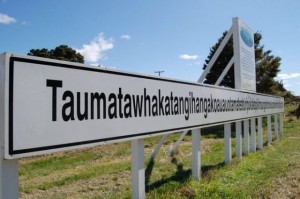

Signpost with the longest place name
in New Zealand and possibly the world.
It means- the place where Tamatea, the
man with the big knees, who slid,
climbed and swallowed mountains,
known as ‘landeater’ played his flute to
his loved one.


Places receive their names for various reasons.  Sometimes they are named because of a family that lived there, sometimes after an eminent person, sometimes because of an industry or after an event.  Sometimes they get their name from a geographical feature.  Sometimes places are named in a more hit and miss way.  A person in a planning office has the task of coming up with a whole batch of new street names, and the only constraint is that they can’t use a name that has already been used elsewhere, so as not to confuse the Fire Brigade.

Our Bible passage this morning is, among other things, about the naming of a couple of places.

It follows a very nasty episode in Shechem, where one of Jacob’s daughters is raped by a man fron one of Shechem’s leading families.  A peace of sorts is brokered.  However the brothers of the woman who was raped are not happy with what was negotiated.  So they attack the town when the men are off guard and sore (part of the peace deal was that the men of Shechem would be circumcised).  These angry sons of Jacob kill the men and loot the village.  The father understands that this act of revenge puts the whole family in jeopardy.  The brothers only see that their sister was wronged and someone needed to pay, and what do they care if it was the whole village.

Jacob had bought land around Shechem, intending to settle there.  Now it was certainly not safe for the family to remain in the area.

Into this situation God speaks to Jacob, ‘Go to Bethel at once and live there.  Build an altar there to me, the God who appeared to you when you were running away from your brother, Esau.’

So Jacob is summoned back to a place where he himself had previously encountered God and found hope, long ago when he was escaping the consequences of his own skulduggery.  Bethel is the place of Jacob’s ladder.  It is the place where Jacob hears for himself the promise that God has made to his family- the promise of the land he lay on, and descendants as numerous as specks of dust.  Through Jacob and his family every nation on earth will be blessed.  Then there is the personal promise, ‘Remember I will be with you and protect you wherever you go, and I will bring you back to this land.  I will not leave you until I have done what I promised.’

To this doorway to the house of God, the gate that he felt opened into heaven, Jacob brings his family, escaping from trouble and danger that they have had a part on bringing on themselves.  Yes, Jacob orders his family to purify themselves and leave behind the vestiges of foreign gods, but Bethel is not shrine for the lily white.  It is a place where sinners, those with murky lives, meet God and are reminded of who they are and the promise they stand in.  It is a place where the frightened find hope.

The account of Jacob setting up the altar at Bethel here in chapter 35 is one of two versions found in Genesis.  The first is found in the Jacob’s ladder story in chapter 28.  There Jacob upends the stone he was using as a pillow, as a memorial stone.  The accounts in both cases are very similar.  The upshot of both is that a place that once was known as Luz, is now known as Bethel, (the house of God).  Something has happened there significant enough to change a place name.  This is a God place now.

There is another place naming in this passage – a poignant one.  Rebekah’s nurse, Deborah, dies near Bethel.  Whether she was Rebekah’s own nurse as she was growing up , or the wetnurse who looked after Rebekah’s first son, Joseph, we don’t know.  But she was someone close to Rebekah, and a loss.  They buried her beneath one of the big trees below Bethel.  (Most translations have oak, but the Hebrew word means any stately tree.) The spot became known as Allon Baccuth – the Tree of Tears.

Through our services over Lent we are looking in a more focussed way at some of the stories of this area.  I’ve been doing some reading around this from the Tawa /Porirua section of the library and I’ve come across some interesting place names and sometimes the stories behind them.  I thought I’d share some of them with you.

The block of land that runs down to the Plimmerton bridge, Section 98 on the first subdivision, was bought by a man called Henry London.  It was the site ofLondon’s accommodation house and his store and a wharf.  Local Maori called it Tinipia.  Large numbers of Maori would call atLondon’s trading potatoes and maize and pigs from settlements in the bay and along the coast.  Henry London used to brew ginger beer, and it was very popular with the Maori who came to trade.  That is why they called it Tinipia (a Maori transliteration of ginger beer).

Had I been a sailor I might have known about this next one before now.  There is an underwater feature called The Bridge.  It runs from the creek valley on Mana Island to the mainland at Bridge Pa, a bit south of Titahi Bay.  Evidently around 8000 years ago Mana Island was part of the mainland.  The shoal or Bridge is all that remains of that connection.  On either side of the Bridge the depth of water can be 2-4 times deeper than the depth of the water on the shoal itself.  The deepest sounding on the shoal is 4.5 fathoms.  Immediately south of the Bridge the water can be as deep as 20 fathoms.  The shoal is an underwater bridge that creates a stretch of shallow water.

One last one will appeal to your sense of humour.  On the harbour side of Paremata Railway Station there was a rag tag collection of cottages along the shore of the harbour.  They disappeared when the motorway was realigned.  They were mostly fisherman’s cottages.  Sometimes on a high tide the sea would wash under them.  They were pretty primitive.  The area was sometimes called Slum Alley or Slug Alley, but it came to be known as Hobson St.  Hobson St in Wellingtonw as a posh street.  Hobson St in Paremata was a joke that stuck.  It is said that some of the Paremata residents were skylarking around Wellington one night and they brought back a souvenir- one of the signposts from Hobson St.  They erected the sign on their own home ground.  The name stuck, and by 1948 had become official.

The names Jacob gave to places reflected what had happened there… Bethel (House of God)… the Tree of Tears.  The place name was a way of remembering.  I want to give you a minute to think of a place that you have lived in or perhaps spent a lot of time working in.  It might be a whole town.  It might be a street or just one building.  Think of the place and the learning that went on in that place….

Forget about the name that that place already has – forget about Luz or Stalag 13 or what ever it was called- and give it your own name, as Jacob did.  What would your name for it be?

What is the prayer or thanksgiving bound up with that name and that place?

Clare Lind

Books used for information

The Bay- A History of Community at Titahi Bay, Linda Fordyce and Kirsten MacLehn, Titahi Bay Residents and Ratepayers Progressive Association, 2000, Titahi Bay.

The Paremata Story, Barbara Heath & Helen Balham, Paremata Residents Association, 1994, Paremata.